Kakuro Is Not Arithmetic: What Really Solves Boards
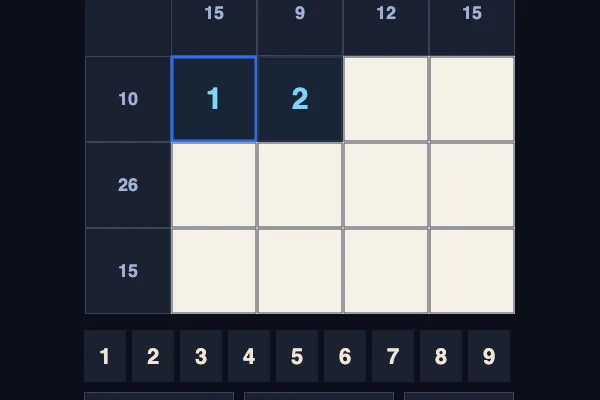
Everyone can count to 45. So beginners sit down at Kakuro Crosswords full of confidence — and stall on the first board. I stalled too. Then it hit me: this game is not about adding at all.
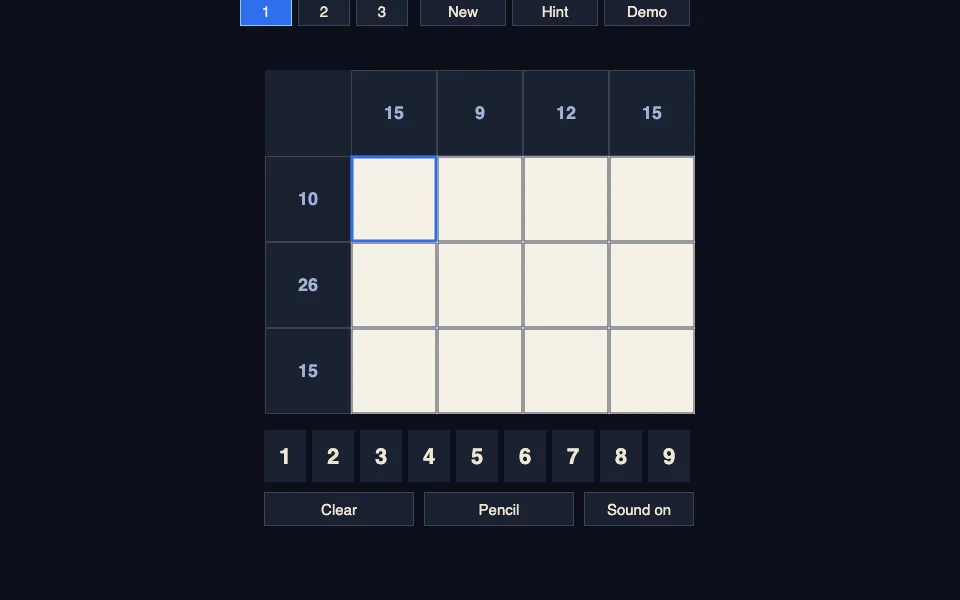
The sums worth knowing by heart
A two-cell block summing to 16 is always 7 and 9. To 17 — 8 and 9. To 3 — 1 and 2. Nothing to compute, it is the alphabet. A player who knows a dozen such pairs clears the opening in a minute, while the arithmetic lover tries combinations and slips. Kakuro rewards memory, not a calculator in your head. I learned the pairs in a week by writing each one down.
Where the game is really played
Mid-game is decided not by sums but by crossings. One cell belongs to two blocks — across and down. Five candidates in each, and their overlap is a single digit. Right-click drops a pencil mark, I mark everything honestly, then hunt the cell where across wants 4-5-6 and down wants 6-7-8. The 6 places itself. I scan for such cells first now, and check sums second.
A disputed tip
Many advise starting with big sums — more clues there, they say. I do the opposite: I go for short two- and three-cell blocks. They have fewer combinations, they close fast, and a closed block cuts the neighbours' options. The board cracks open from the edges. Try both ways on three boards and count the mistakes — my score is 3:0 for the short ones.