Urn Coin: 219 coins, not one of them random
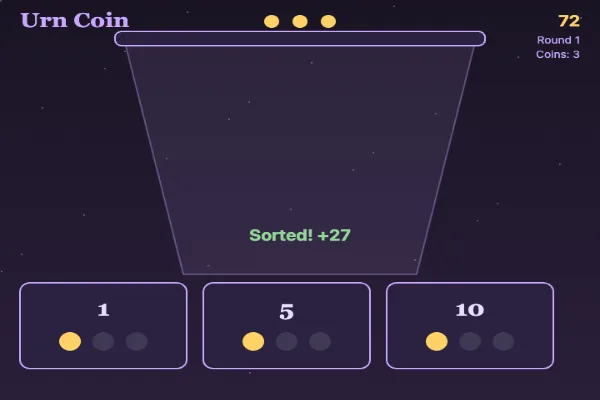
On round twenty-five the score reads 11,628, the streak is 219, and not a single coin hit the floor. I didn't press anything: I switched on the demo autopilot, came back a minute later, and saw exactly the number I had worked out on paper beforehand.
The calculation was easy because the score here depends on quantity, not dexterity. A sorted coin pays 18 points plus three for every coin in the streak, and the streak counts no higher than twelve. The first coin pays 21, the second 24, the twelfth 54, and after that every coin pays 54 as well. Once twelve coins are sorted the score stands at 450, and each further coin adds exactly 54.
In one minute the autopilot sorted 219 coins: twenty-four full rounds of nine coins and three more. 450 plus 207 coins at 54 is 11,628. It matched to the point, and it had to: the score for a coin comes from a single line of code with no time, no precision and no bonus for speed in it.
Where randomness might have been
Coins fall one at a time, and three cells with denominations wait below. On the first round they are 1, 5 and 10; on the second 5, 25 and 50; on the third 10, 50 and 100. The base cycles back to the start every five rounds. A cell holds three coins, and nine sorted coins close the round.
The first thing I checked was how a coin is chosen. The game file contains not a single Math.random. The denomination is taken from the cells that still have room, and the index is the round number plus the number of coins already sorted, modulo the number of free cells. I logged all 219 appearances: on every one of them the formula matched what fell onto the screen. There is no randomness at all; the sequence is fixed before the run and repeats if you play the same way.
There is an odd consequence. The game looks like a reaction to surprise, when in fact it is a task of executing a known script. A coin can't "be anything" — it is decided in advance, and the only thing you choose is whether you hit the cell before it touches the bottom.
Three lives and 7.3 seconds
A missed coin costs a life, a wrong cell costs a life, and a tap on a full cell costs a life too. You have three. I started the game and left it alone: the first coin took 2.19 seconds to fall to the bottom, then two more fell, and after 7.3 seconds the screen said the coin had broken, with zero points and round one still running. Doing nothing is not a pause here; it is a loss.
Speed grows by 7 pixels per second each round and stops growing on round fifteen: 96 plus 15 times 7 is 201 pixels per second against 103 on round one. The fall time shrinks from 2.19 to 1.12 seconds, roughly half, and that is the ceiling. After that the game doesn't speed up — it only stretches.
The ceiling doesn't bother the autopilot: it checks the screen every 60 milliseconds and doesn't miss. By round twenty-five it had sorted 219 coins in a row, and I closed the tab not because it failed but because watching a robot sort coins by a formula you already know is interesting exactly until the moment you realise the result was calculated in advance.
Play Urn Coin for free: /en/games/U-X/U/urn-coin