Idle Dungeon: the hint that shops for the cheapest
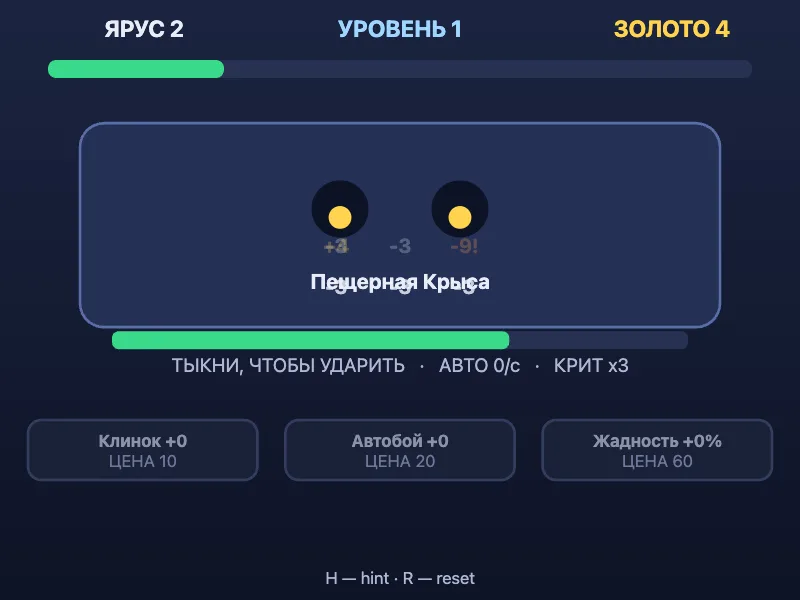
The bot with the H key stopped at floor 27. The bot that knew one purchase, Blade, stopped at 30. Both hit the monster ten times a second, both started on the same screen: twelve hit points on the floor-one creature, three damage per strike. The only difference was where the gold went.
I opened five copies of the game in a headless browser and gave each sixty seconds. Each tapped the centre of the screen at ten hertz and followed its own buying rule: one bought nothing, one only Blade, one only Auto-strike, one only Greed, and the fifth obeyed bestBuy, which is the function behind H, every two hundred milliseconds. One run per strategy and one minute is not a verdict on an hour-long strategy, but the gap was too wide to wave away as luck.
| Rule | Floor | Gold | Level | Upgrades | Score |
|---|---|---|---|---|---|
| no purchases | 16 | 307 | 4 | 0/0/0 | 210 |
| Blade | 30 | 70 | 6 | 9/0/0 | 337 |
| Auto-strike | 17 | 20 | 4 | 0/5/0 | 192 |
| Greed | 17 | 41 | 4 | 0/0/3 | 194 |
| hint H | 27 | 72 | 5 | 7/5/2 | 302 |
Hoarding is pointless: 307 gold sat dead while depth stalled at floor 16, because damage hadn't moved. Nine Blade levels cost 945 gold and carried the bot to 30. Five Auto-strike levels cost 316 and stopped at 17. That doesn't make Auto-strike broken: it adds damage on top of your taps rather than replacing them.
What the hint actually returns
The game's description says H will hint the best purchase. In the code the job belongs to bestBuy. It collects three prices — Blade 10 times 1.55 to the level, Auto-strike 20 times 1.6, Greed 60 times 1.7 — and returns the upgrade you can afford that is cheaper than the other affordable ones. The word "best" never enters the calculation: neither damage gain nor gold gain is estimated anywhere.
Until you hold ten gold, H returns nothing. After that it behaves predictably: the first two purchases are Blade at 10 and 15, because Blade is cheaper than Auto-strike. The third is Auto-strike: the next Blade costs 24 while Auto-strike still costs 20. The gold starts scattering from the third press. By the fifteenth second the H bot owned three Blade levels and one Auto-strike; the single-rule bot owned five Blade levels.
At the end of the minute it was 7/5/2 against 9/0/0. Both strategies spent comparable sums, 859 and 945 gold, but the scattered money produced less damage.
A frame you see after buying
The hint also has a visible part: the remembered button gets a yellow outline. The condition in the code is "this button is hinted and currently unaffordable". At the moment you press H the hint by definition picks something you can afford, so the yellow frame never appears then: the button is green.
I checked it on the live page. Ten gold, press H: the hint says Blade, the frame is green. Buy it: gold drops to zero, the next level costs 15, and now the same button turns yellow. The hint lights up not when it advises, but when its advice has grown expensive enough that you can't take it.
The same file keeps another little signal: strikes closer together than seven hundred milliseconds raise a combo counter up to five. No damage, gold or price depends on that counter, and nothing else reads it. Such details don't break the game; they just stop you believing that the things on screen mean something.
Twenty seconds without a single action
Auto-strike costs twenty gold, and gold comes only from kills. I opened the game and left it alone for twenty seconds: floor one, twelve hit points, zero gold, zero kills. The dungeon is in the name, the idle is in the name, yet it only starts moving after you have tapped your first twenty gold.
I don't expect the hint to be fixed: cheap and profitable coincide only at the very beginning. But pressing H has become more interesting than buying by hand — at least to see where the next thirty gold will leak.
Play Idle Dungeon: Long Nights for free: /en/games/I-L/I/idle-dungeon