Downlink: Satellite Passes
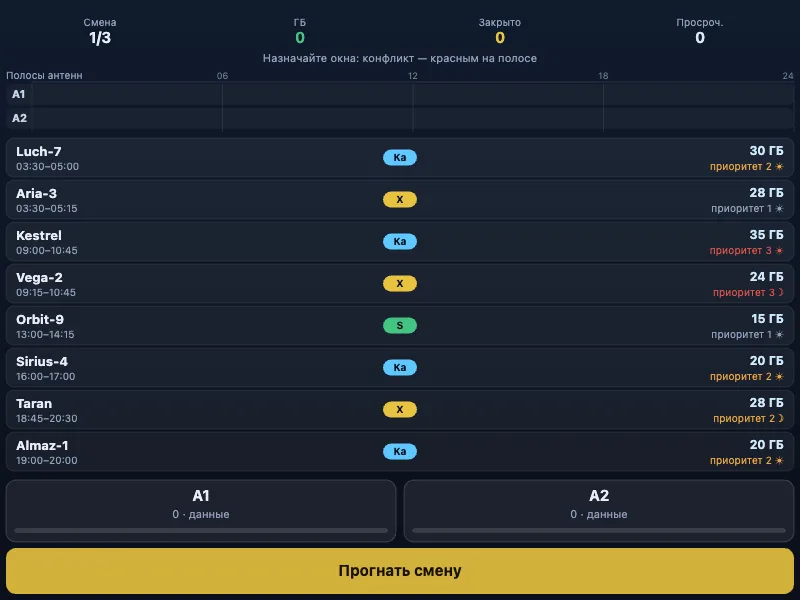
A deep-space ground station is a queue with a timetable on top and hardware underneath. Downlink is built on that conflict: pass windows are fixed in advance and cannot be moved, but you decide which window goes to whom.

Why it is a puzzle and not a clicker. A pass has a start, an end and a volume. If the data does not fit the window, the frame stays on board until the next orbit, and the next orbit may be tomorrow. The antenna slews slowly, handover between spacecraft costs time, and the receiver heats up and needs a pause. Two passes scheduled back to back are often physically incompatible, so the plan has to be built before the first contact.
Energy and priority. Each satellite has its own budget: in eclipse it lives on battery, and a heavy exposure in bad light costs more than the same exposure in sunlight. A high-priority request is not necessarily valuable — it is simply someone's urgent, and taking a whole window for it is a decision rather than a default.
How to work the shift. First mark the impossible: passes that cannot follow each other get crossed out before any receiving starts. Then take the long windows — they feed the queue. Short windows between them are filled with jobs that fit entirely and need no slew. Whatever time is left goes to cooling the receiver: a hot antenna receives nothing, and the shift ends with a beautiful plan and an empty archive.