Tic Tac Toe: a solved game, and playing it anyway

Be warned up front: you will not win. This opponent runs minimax with a full search — it looks at every continuation to the end of the game and always picks an optimal move. Against perfect play the best available result is a draw, and that is not a limitation of the implementation, it is a property of the game.
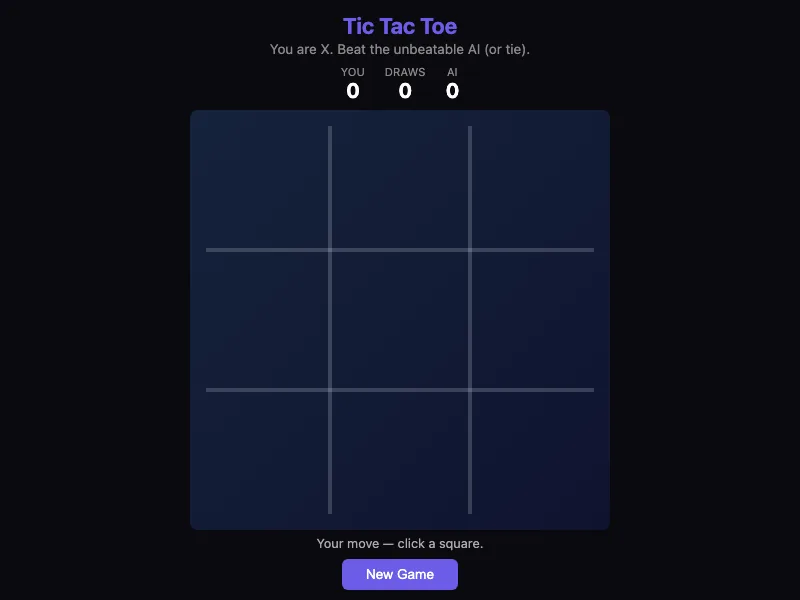
So what is the point?
The goal shifts. You are not playing to win, you are playing not to lose — and that turns out to be a genuine skill. Nine squares, three symbols, and yet the average player loses this "trivial" game to a machine within a few moves.
The moment you draw ten in a row, you have actually learned something: how to see threats before they become threats.
The two mistakes that lose it
The first is grabbing the wrong first square. The centre is the strongest cell because it takes part in four lines out of eight; a corner is second best; an edge is the weakest and hands the initiative straight over.
The second, and the real killer, is the fork. That is a position where the opponent has two winning threats at once, and a single move cannot block both. You do not lose on the move where you notice the fork — you lost two moves earlier, when you let the shape form. Blocking is reactive; the way out is to keep an eye on which cells create double threats and take them yourself.
What to try after that
- Play out ten games as X and count how many end in a draw. That number is your real score.
- Then look for forks yourself: play so that the AI has to block, not you. It will still hold the draw, but you will start reading the board differently.
- Watch the win/loss/draw counter. A pile of losses is not the AI being cruel, it is a specific pattern you keep repeating.
Click a square to move; New Game starts over. Five minutes here does more for board vision than an hour of a big strategy game.