Tidewright: the sandcastle that was never going to hold
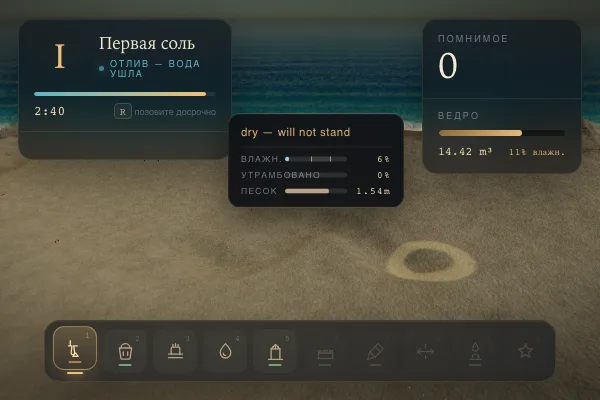
This game looks like a calm simulator: sea, sand, a clock. In fact it is a very fussy piece of physics that checks every decision you make. Here is what is going on and how to come out with a decent score.

What it actually is
Tidewright is a sandbox. You build a castle out of sand, the water arrives on schedule and tries to take it apart. There is no tutorial story: the rules are on a wall as text, and the rest you work out by experiment.
The sand is not real sand but a coarse physical approximation — and it is the honest angle of repose that makes everything interesting.
The one law: dry sand cannot stand
Every grain has an angle it refuses to exceed. Dry, that is about 33 degrees: a slope, never a wall. The moment you try to build a vertical tower out of dry material it collapses. That is not a bug, that is the law of physics.
Wet the grains and the behaviour changes. Water acts as glue: damp sand holds a vertical line and even an overhang. But do not overdo it — saturated sand turns into a liquid and runs on its own.
The sweet spot is damp, not soaked. That is why the game has a probe under your cursor: it tells you what the sand there is like, and warns you in advance when it is too dry to hold.
Tamping is the other half of strength
Damp sand and packed sand are different materials. Tamping binds the grains tighter, and a packed wall lasts far longer than an untouched one. The skill is in tamping the things that actually carry load: the base, the walls, the parapet — not everything indiscriminately.
Sand is neither created nor destroyed
That constraint makes you plan ahead. Dig a moat and the spoil goes into your pail; pour the pail back into the world. The amount of sand is constant and you cannot simply conjure material.
The practical consequence: dig your moat where you want the moat, and build the spoil straight into a berm. Otherwise you spend the whole tide hauling sand around.
A moat and a berm do different jobs
A wave breaks where the water goes thin, and it eats the base first. Undermine a wall and it falls on its own — a consequence of the simulation, not a scripted event.
So you need two things: a moat that spends the wave's energy, and a long low packed berm on the seaward side that turns it. A moat without a berm lets the wave into the keep; a berm without a moat just softens the hit.
The score is Remembrance
The score does not count your buildings. It counts the sand you lifted above the tide line, weighted by how well you packed it. The uncomfortable but correct conclusion: a big loose pile scores less than a small, densely tamped wall.
And the good news: the score never goes down when you fail. The sea takes the castle, not the memory of it. You can lose as often as you like.
Nine tides and two other modes
The campaign is nine tides, from morning light to the dark water, each harder than the last. Besides it there is Slack Water — a whole day on the shore with no clock and no tide, purely for experimenting with shapes. And Endless Sand: a bottomless pail and a sea that never comes in, build as long as you like.
The in-game codex describes every tool and rule, so look there when something is unclear.
Verdict
Small in lines of code, unusually dense in physics: there is not a single pre-written collapse animation in it. A wall falls because it was undermined. It is a rare and pleasant feeling when destruction is a consequence of physics rather than a script.