Orbital Puzzle: a close look, tips and whether it is worth your time
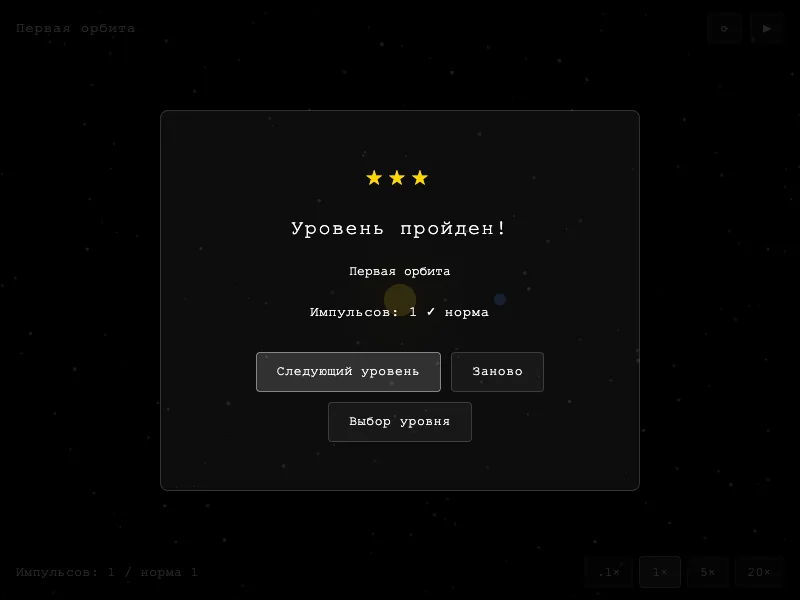
If you like puzzles where one precise maneuver beats ten random guesses, this is it. Here is everything worth knowing before the first launch: the gist, the controls and a few techniques that actually work.

What this game is
Orbit Mechanic is an orbital-mechanics puzzle running on real Newtonian physics. No faked trajectories: every body pulls every other, and your job is to place a satellite, set its velocity with a single drag, and guide the spacecraft onto exactly the orbit the level asks for. Thirty levels span four acts — from a first circular orbit up to gravity assists, libration points and resonances. It is all drawn on plain Canvas, with no external physics engine.
How to play, in short
Click to place a body, then drag from it to set a velocity vector (the length sets the burn magnitude, the direction is where you pull). After that the physics takes over: the craft flies whatever you gave it, while a live preview and the orbital elements — semi-major axis, eccentricity, period — show where it is headed. Wheel to zoom, Shift-drag or middle-click to pan, space to pause, keys 1–4 to scale time. Every level is rated in stars for burn count and fuel efficiency, so you can keep solving the same puzzle ever more cleanly.
Controls
On a phone it is all the same with a finger: tap to place a body, swipe from it to set the burn. On the desktop it is mouse and keys. On the later levels the trajectory preview starts lying (three-body systems are chaotic), and that is not a bug but part of the lesson — learn to trust the physics, not the hint. After the eighth level a sandbox opens: any number of bodies, any masses, save and load configurations, no win conditions.
A couple of tips to finish
- Don't rush to drag a long vector: for a circular orbit at a given radius the speed is nearly fixed — pull strictly perpendicular to the line to the center and the preview will give you a circle.
- A Hohmann transfer is exactly two burns: the first raises your apoapsis to the target orbit, the second circularizes at apoapsis. Extra burns waste fuel and cost you a star.
- A gravity assist gives energy "for free": pass just behind a planet along its motion and it hands you part of its momentum.
Just the kind of puzzle where "one more precise maneuver" turns into an evening. Ready to try? "Orbital Puzzle"