Hex: a bridge is built from both ends
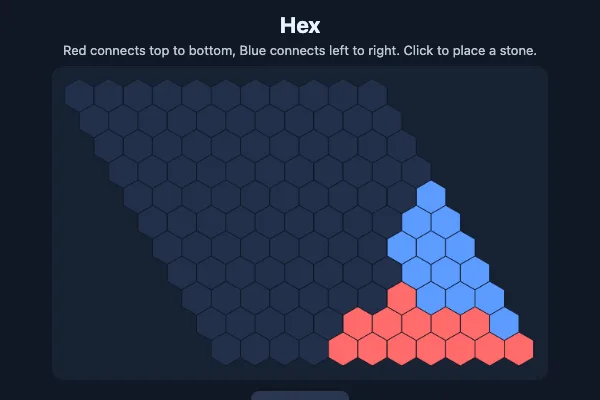
My stone landed in the centre of the board, and I regretted it at once. My red stones held each other, stretching top to bottom, when a blue wedge cut in from the side and sliced my path in half. One move, and my bridge became two islands.
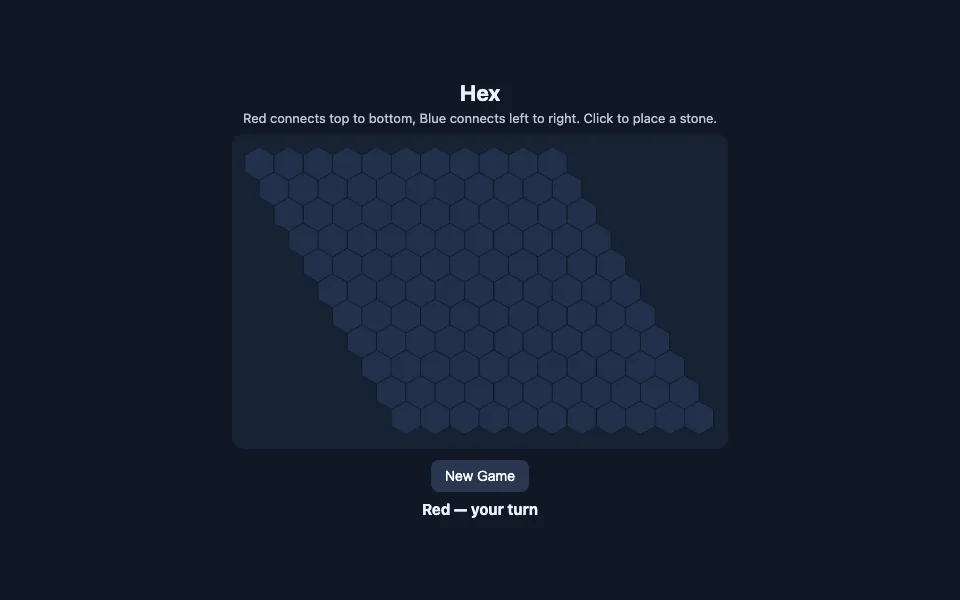
My Take: the Centre Is Overrated
They say about Hex: take the middle and the board is yours. That is what I did. I placed a stone on an empty central cell and waited for my rival to flinch. It did not flinch. The greedy heuristic of the machine knows no fear: it builds its own edge-to-edge path and cuts yours at the first chance.
The rules are shorter than a receipt: red connects top and bottom, blue connects left and right. Players take turns, neighbouring stones of one colour merge into a path. That is all. Then begins what the rules never mention: every stone of yours is a brick of your own bridge and a wall across someone else's.
What Decides the Game
I lost three games in a row before I saw the pattern. The winner is not the one who reaches the edge faster, but the one who blocks the rival road first. My central stone was beautiful and useless: it led nowhere.
The turning game looked boring. I placed stones along the blue left flank, refusing to let them join. My rival scrambled: every move patched a hole while my own path grew together on its own. Victory came with no grand finale — the board simply filled with my path.
Why There Is No Draw
Hex has a curious property: a full board always holds a winner. A draw is mathematically impossible. It sounds like a trifle, yet it changes the feel: the game must end with someone's bridge. Build yours, or watch someone else's close right under your nose.
In demo mode the machine plays itself. Watch one such game: you can see a path gather from scattered stones into a single line.