Hitori: Cross Out Doubles — the puzzle of lonely numbers
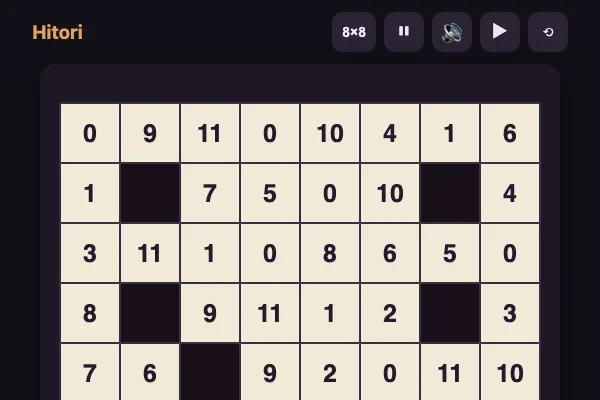
Sudoku's dark twin
Sudoku arranges numbers so duplicates never appear; Hitori does the opposite. The grid is messy on purpose — repeats everywhere — and your job is to blacken the extras. You get a square filled with numbers from 1 up to the grid size. Some duplicates are harmless, some must go. Cross out exactly the right ones.
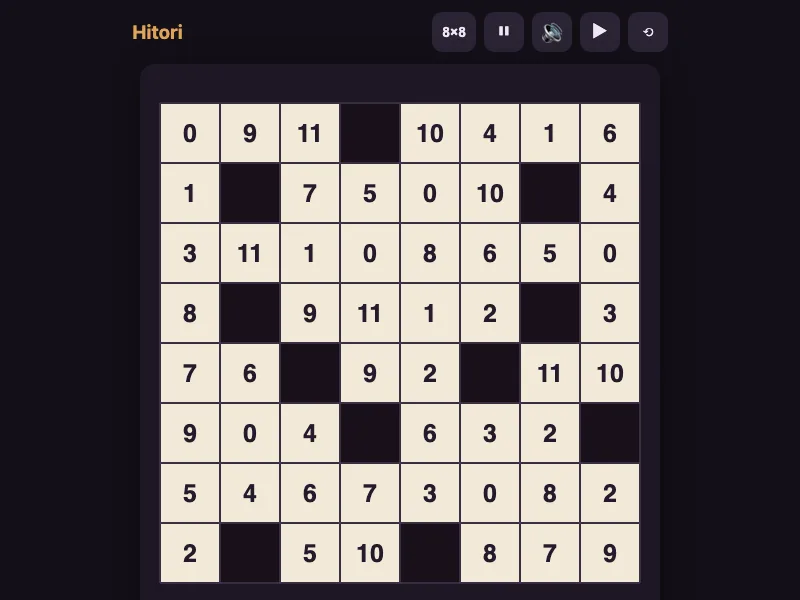
Three rules
1. No duplicates: every row and every column must be free of identical visible numbers.
2. Blacks don't touch: crossed-out cells never share an edge — diagonal contact is all they get.
3. Whites hang together: the remaining cells must form one connected region, no orphaned white islands.
How to think
Start with adjacent pairs: two identical numbers side by side in a row mean one of them goes black, and everything around a black cell turns white automatically. Then the two constraints kick in — no touching blacks, no cut-off whites. Beautiful deductions are born exactly where those bans intersect.
In our version one click blacks a cell out, a second click restores it. Half-moves are fine — the board forgives.
Why it hooks you
Hitori is that rare case where three rules buy years of depth. A 6×6 board is a two-minute warm-up; 8×8 is a proper task. Every board is generated fresh and verified to have a unique solution — the clues never lie.