Triage: Emergency Intake
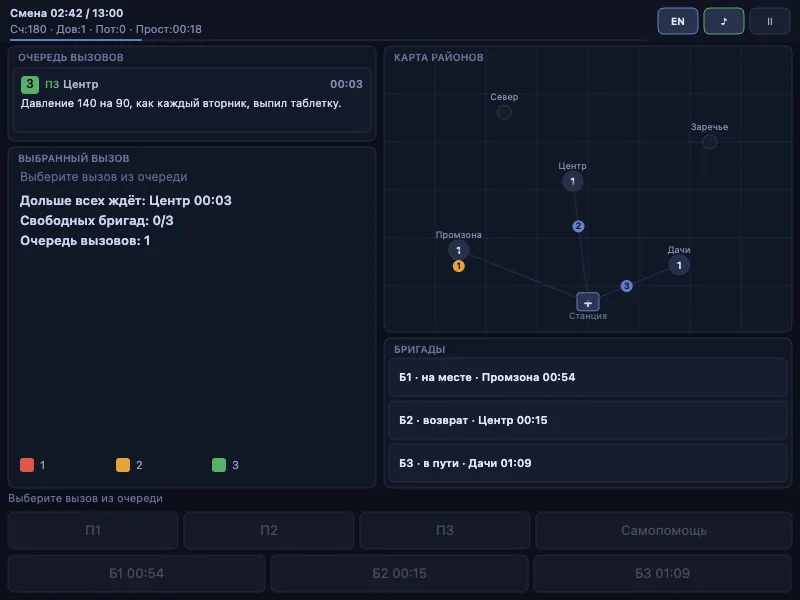
A dispatcher's shift is not a reaction test. It is three problems at once: judge severity from a description, allocate a limited fleet, and keep an eye on everyone still waiting. In Triage each of them changes the other two, which puts the game among resource-economy simulators rather than arcade clickers.

How to read a call. Severity is hidden on purpose: it is not in the header and it is not printed in red. You infer it from signs — what the caller actually says, how coherent the sentences are, how many minutes have passed. Real dispatch answers weak signs with watch-and-wait, and the game punishes the opposite: a car sent to a false alarm is a car missing when a serious patient appears.
Why time matters. A patient is not static: while queued, they deteriorate. Priority given to a mild case is minutes stolen from a severe one. The crew is not omnipotent either — it drives, works and returns, and a district far from the station costs a large slice of the shift. Mistakes are paid in time, not points, and the shift has a fixed amount of it.
Opening tactics. Keep one unit uncommitted: without a reserve, the first false alarm stalls half the city. Do not promote everything to top priority — the queue stops meaning anything and you lose exactly the patients waiting could have saved. Count distance: three nearby mild calls are often cheaper than one distant severe one, and the debrief says so plainly.