Demolition: the fuse never asks who lit it
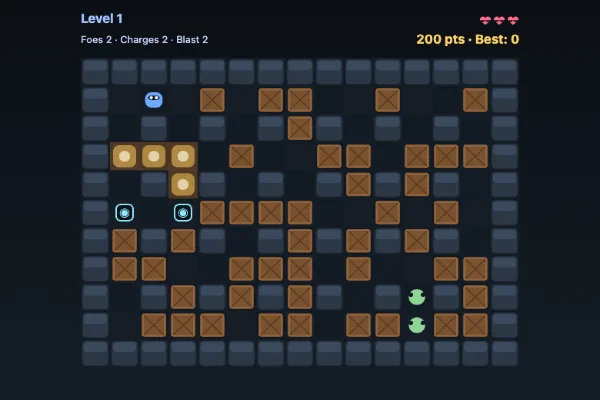
Two seconds of fuse is about fourteen steps. I managed one.
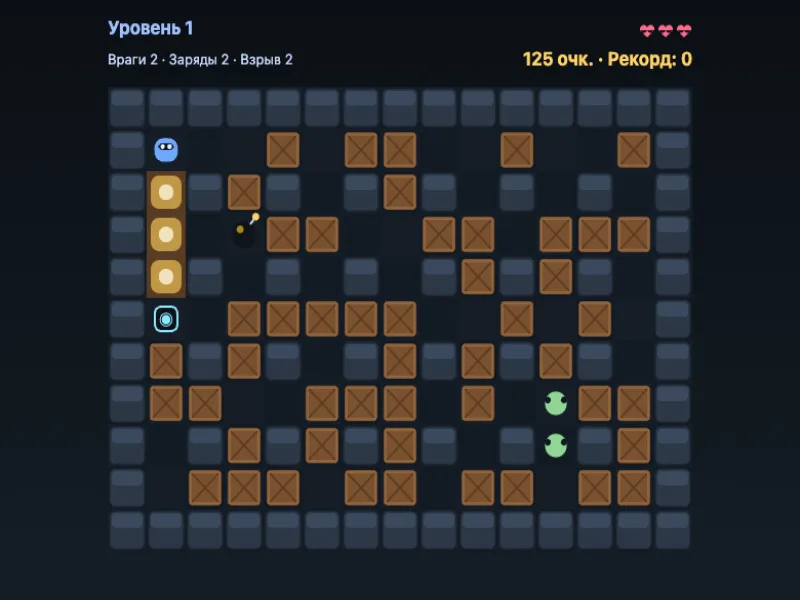
A cell in Demolition takes a fraction of a second to cross, so outrunning your own charge is easy — provided you already know which way you are going. The shape of the blast is the problem. It runs as a cross and strikes both ways at once: plant a charge next to a crate and you have planted it in a corridor that leads back to you. There are no diagonals to slip through; four directions is all you get.
One crate on level one
I broke a crate from right beside it. My reasoning was that the blast would spend itself on the crate and stop. It tore the crate apart and came back down my side of the row. Charge power is two cells, and I was standing on the second.
Behind me was a corner of two walls. I got one step in and stopped, because the rest was brick. One life gone on a level with two foes that cannot even hunt yet.
Who else is alive down there
Foes multiply as you go, and they behave differently. Crawlers wander at random, and you can pass one in a side corridor. Hunters walk at you along the shortest path, and a turn does not shake them off: they turn with you. Ghosts arrive from level four. They drift straight through crates, so a maze you have not cleared is not a wall to them but a shortcut.
What the crates hold
Crates are the only source of power-ups: an extra charge, a bigger blast, faster boots, and now and then a spare life. The extra charge looks like the best of them and turns out to be the worst. Two charges on the field mean two crosses overlapping, and the gap between them narrows.
The hatch
The hatch opens once nobody but you is left in the maze. It sits on an empty cell, and finding it is a job in itself: until the maze is opened up, there may be no way through to it at all.
These days I look at where I will come out before I press Space. Sometimes I still misjudge it — the fuse never asks who lit it.