Crab Dash
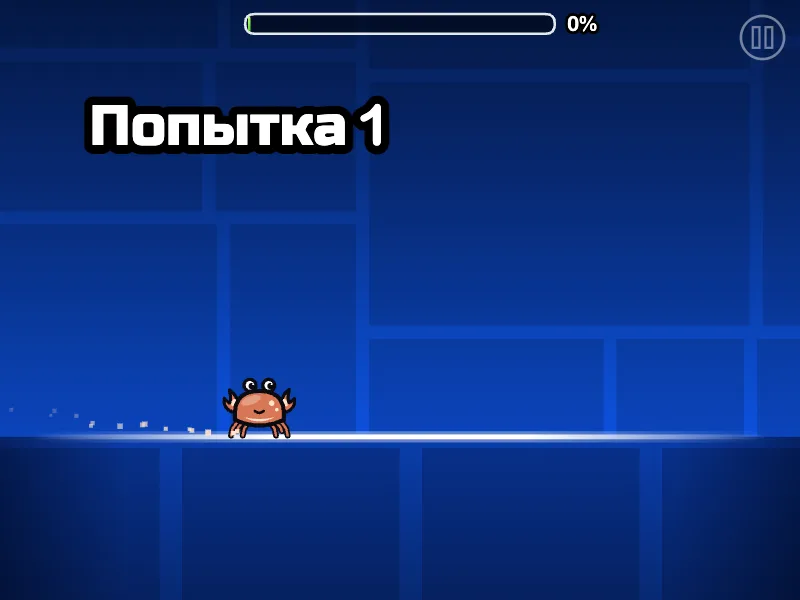
One button, seven different physics problems. Crab Dash belongs to the auto-runner family with a single verb: the character runs by itself and the player only picks the moment. In this genre the moment is the whole game, because a level is laid out around tempo rather than distance.
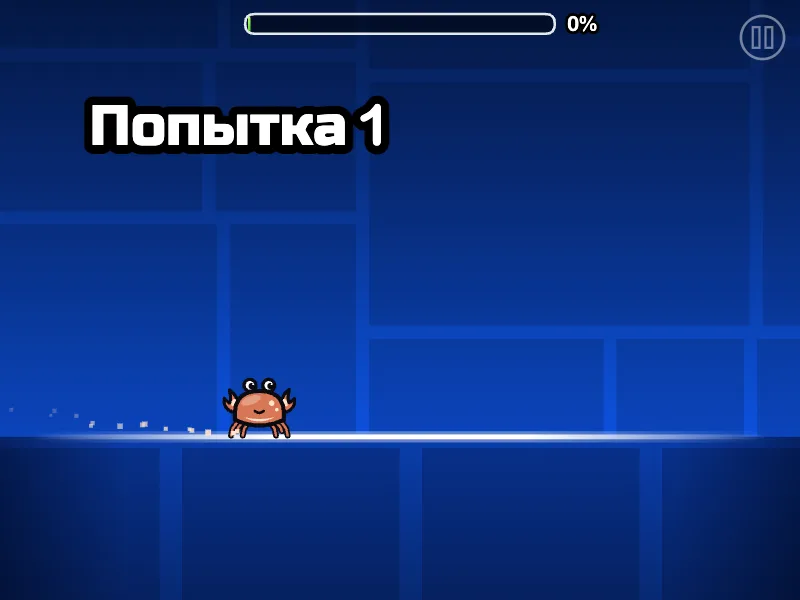
Why there is something to plan. Seven physics modes: cube, ship, ball, ufo, wave, robot, spider. Each has its own curve — the ship listens to hold, the wave travels on a fixed diagonal, the robot distinguishes a tap from a long press, the ball flips gravity on jump. Speed portals range from 0.5x to 4x, and jump height does not grow with speed, so a gap the cube cleared at 1x only clears at 4x from a pad or an orb. Gravity portals mirror the reading of the level. Learning one pattern does not carry you into the next level: the timing has to be read again.
Honest difficulty. The simulation steps 240 times a second and it is deterministic: the exact code that moves the crab in the game also runs the solvability checker and the editor. So a level you built is either beatable with 60 Hz input or not beatable at all — maybe it works on a good run is not an argument here.
How to clear it. The first pass is reading, not record setting: levels are short and attempts are counted separately from the result. Practice mode with checkpoints is not a soft option: it lets you take one hard bar apart twenty times instead of the whole level again. Secret coins usually sit off the safe line, you pay attempts for them, and that is a fair trade.
Then the editor. Once clearing stopped being the challenge, start building: the block, portal and pad set is the same one the six authored levels use, and the built-in check says straight away whether your layout is solvable.