Brothers: six moves for two, and none of them come back
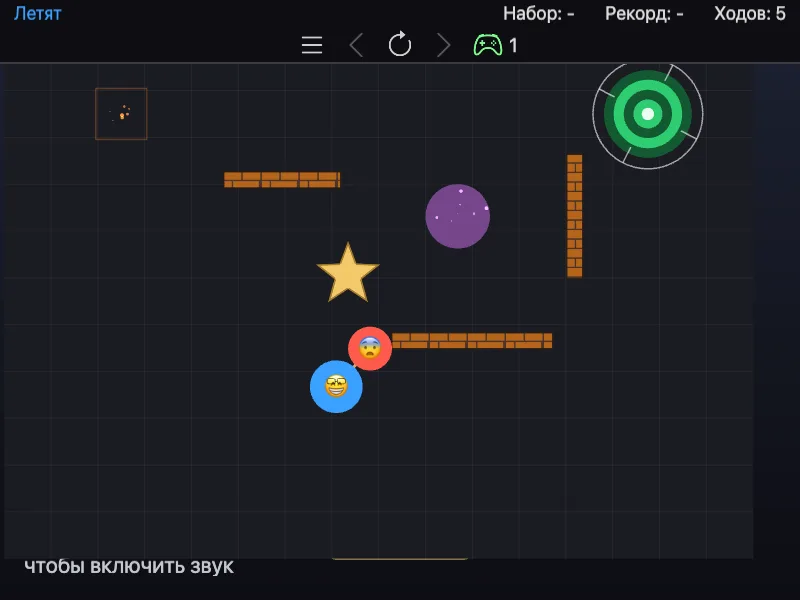
It looks like an arcade game: two balls on a rubber band, a target ring, a few walls. In practice it is a problem about economy. You get six moves, they never come back, and reaching the ring is not meant to happen on the first throw. Here is what a good solution is made of.

One turn, one simple rule
The brother who is glowing is the one you move. Drag him back and release: the band throws him into his partner, the partner is freed, and both fly onward on the stretched tether. That is the whole move. One gesture costs one of your six moves, and the counter goes down for good. Everything else follows from that — a miss costs exactly as much as a hit.
Power is not the answer
A gentle throw carries the pair a short way; a hard one carries them far, but usually past the target. Levels are built out of walls and gaps, so a long run often ends in a corner while a short, careful one threads through. The practical rule: find the line that physically fits first, then add power. The throw that looks best in a preview is the one most likely to end against brickwork.
The anchor pin changes the shot
Most elastic-band puzzles measure the throw from one ball to the other. Here the origin is the anchor's pin, and the pin moves. A single tap snaps the brother to the nearest compass point, a double tap puts him dead centre, a drag fine-tunes. A shifted pin changes both direction and strength at the same pull, so the same stretch with different pins is a different problem entirely. It is a cheap way around a wall without spending a move on a run-up.
A wall can pin you
Usually a wall just blocks and bounces. But if the pair ends up in a corner, the band can press them both against it, and the move is gone along with the pair. Check the geometry before you throw: is there anywhere for them to land at all. A teleporter is more of a gamble than a tool — sometimes it drops you at the ring, sometimes on the far side of the map.
Bombs do not stand still
Level three adds bombs, each with a spinning arrow: the direction of its first move, and how fast the arrow spins is how fast it goes. While the arrow turns, the bomb is moving, so by the time you reach it, it is not there. Bombs cannot be planned around, only reacted to — and often the best play is not to throw near one at all and let it travel behind you.
Mud, and David's bedroom
Mud slows you down. Normal mud shakes off within a couple of turns; the dark sticky patch holds until you rinse it with the Ultra Cleaner, which means that on a muddy level the real skill is not getting dirty again. Levels five and six move the whole thing into David's bedroom: furniture, Legos stashed in the closet, and a monster you have to slip past using bounces, because walking the hallway is not an option.
What is actually scored
The score is not time and not points — it is how many moves you had left when you won. The higher the better. That is an unusual scale: it rewards precision rather than speed, so "cleared on the first throw" counts for less than "cleared with two moves spare". Each level keeps its own best and the pack adds them up, with the total going to the site's shared leaderboard.