Word Scramble: two word lists, one habit
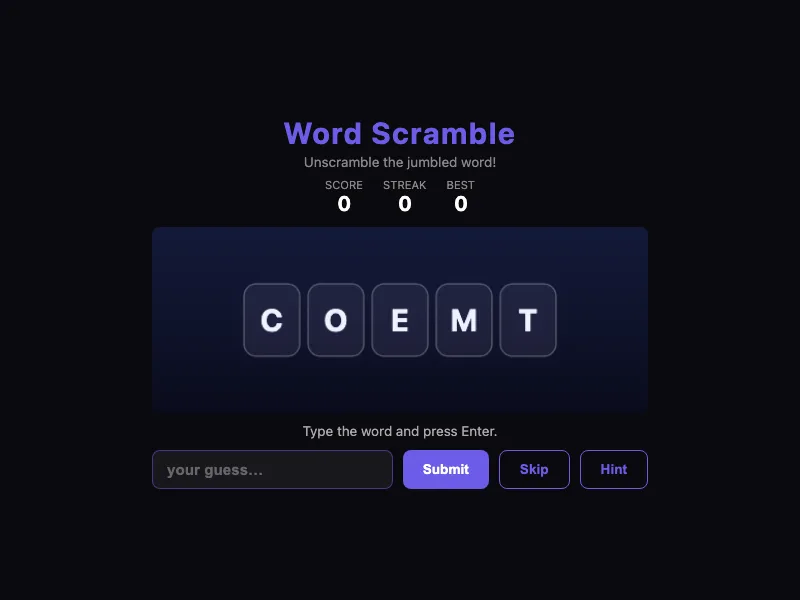
A word appears with its letters shuffled; type the original. The rules end there, and everything interesting is in how your brain refuses to do it the efficient way.
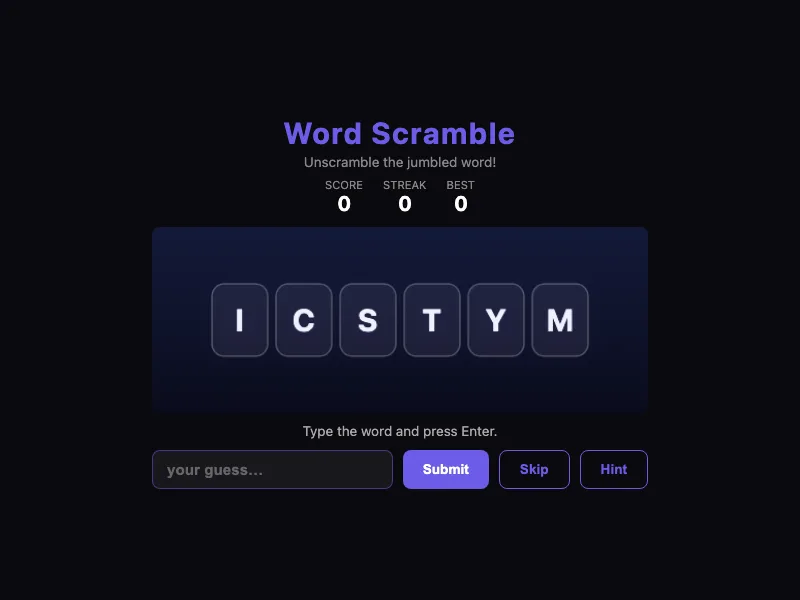
Why you get stuck on easy words
Reading is pattern recognition, not letter-by-letter assembly. Shuffled letters break the pattern, so recognition has nothing to grab and you fall back to brute force — trying arrangements one at a time. That is slow and it is why a five-letter word you know perfectly well can hold you up for half a minute.
The fix is not to try harder but to stop assembling. Look for a fragment instead: a familiar pair of letters, an ending, a prefix. Once two or three letters lock into a plausible chunk, the whole word usually arrives at once.
Streak versus hints
Points come from the streak. A correct answer extends it, a wrong one resets it — and this is where the two buttons below the input become a real decision.
Hint reveals one letter by position. Cheap, and it often unlocks the word instantly. Skip shows the answer and moves on, but it ends the run you were building. So the rule of thumb is: take the hint early, not after you have already burned a minute, and treat Skip as the last resort rather than an escape from mild discomfort.
Two languages, two different games
Each language has its own word list — Russian words in the Russian version, English in the English one. They do not feel alike. Russian words carry more inflectional endings, which is a gift: spot the ending and you have cut the search space enormously. English relies more on fixed consonant clusters — th, ing, str — which is a different kind of hook.
If you are learning either language, the game works as vocabulary practice, because it forces recall rather than recognition. Switch languages with the site's language toggle and the word list follows.