Sandspiel: a sandbox where the physics runs in WebAssembly
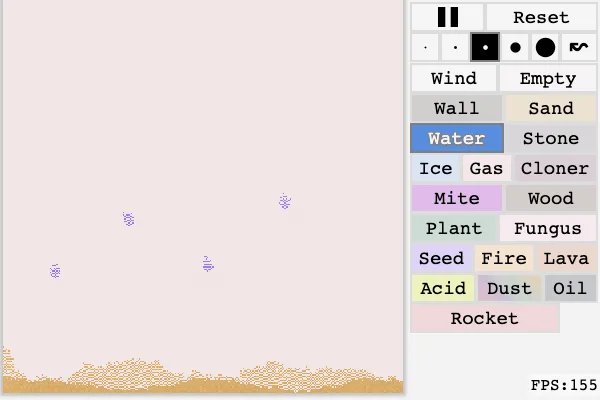
Sandbox games promise "creative freedom" but usually ship a pile of blocks glued together. Sandspiel is a different breed: every single cell of its 300×300 field has a personality. Sand pours, water flows and evaporates, fire runs along wood, acid dissolves nearly everything, and fungus slowly devours all organic matter in its path. There is no level script — only interaction rules between eighteen elements.
What's inside
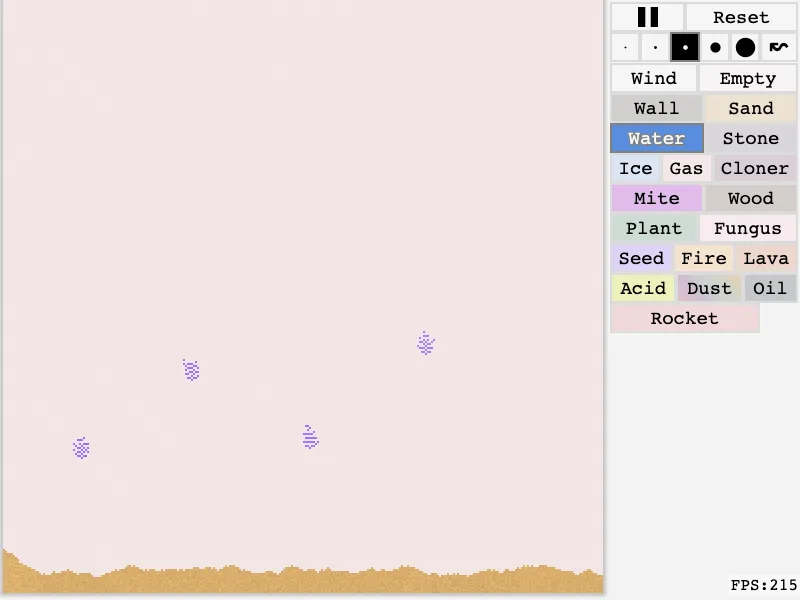
- 18 elements: sand, water, stone, ice, gas, acid, lava, fire, oil, dust, wood, plant, fungus, seed, mite, cloner, rocket, wall — and an eraser.
- Real physics: the cellular automaton is written in Rust and compiled to WebAssembly, so 90,000 cells are recomputed every frame even on a phone.
- Fluids on top: water and smoke run through a separate WebGL fluid simulation, so they flow smoothly instead of stepping block by block.
- Wind: the Wind button turns your cursor into a hair dryer — fan the flames and the steam.
- Five brush sizes — from a thin trickle of sand to an avalanche.
Why it works
The original Sandspiel is a cult browser sandbox (by Max Bittker, MIT-licensed) played by millions. We stripped everything unnecessary — trackers, ads, mandatory accounts — and kept a pure laboratory of elements, fully available in Russian and English. There is no win or lose condition here: the only goal is to see what happens when you pour water onto lava, or drop seeds into a thick wall of sand.