Puyo Puzzle: the chain matters more than the clear
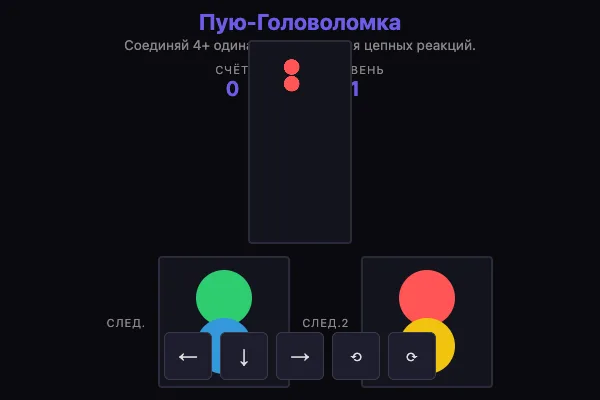
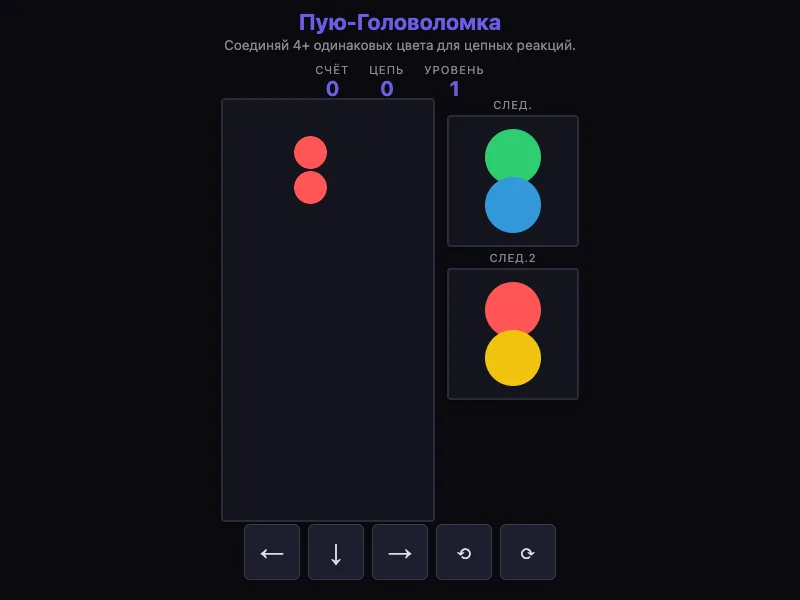
Pairs of coloured blobs fall from the top. Four of the same colour in a line pop. If you stop reading the rules here, you will play badly — but you will play, and that is the trap of this genre.
Why single clears are a losing habit
When a group disappears, the blobs above it fall. If the fall creates a new group of four, the next link fires by itself. That is a chain, and it is where all the points live: one well-prepared structure outscores a long run of tidy single clears many times over.
The consequence is counter-intuitive. A player who pops every four they see keeps a clean board and a low score. A player who builds a slightly frightening pile and then triggers it wins. Restraint beats tidiness here.
How chains are actually built
A chain is layers. You place a group of three of one colour, cover it with three of another, and leave a single spot where the fourth blob completes the bottom layer. The bottom clears, the upper layer drops, completes itself, and fires. Add a third layer and you have a three-chain.
Colour distribution is the part beginners ignore. If one colour is scattered across four columns, none of those columns can be finished. Better to accept an untidy stack of the same colour in one place than to smear it evenly across the field.
Practical notes
- Keep one column low — that is where you drop the trigger pair. A wall with no doorway cannot be fired.
- Rotation near a wall is limited. Turn the pair before it gets to the edge, not after.
- Watch the incoming pair and place the current one for it, not for itself.
- Losing on a full well because you were building a five-chain is normal. That is what practice is for.
Controls are arrows to move, Z and X to rotate, on-screen buttons on touch.