Parity: 100 levels where a single move decides everything
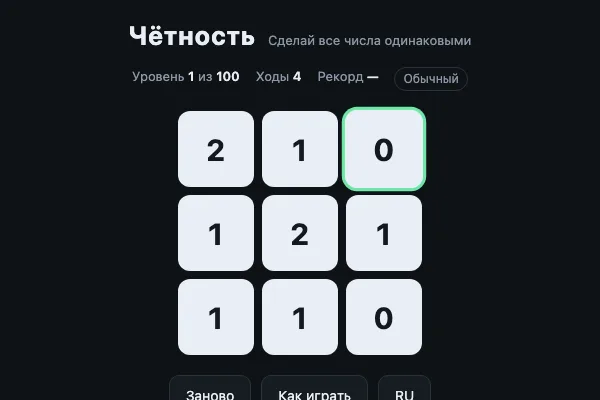
Sometimes the best puzzle is the one you can explain in a single sentence. Parity has a 3×3 board of numbers and a cursor. Move the cursor and the number in the cell you LEFT changes. Make all nine numbers equal.
Where the catch is
The rule sounds harmless: leave a cell and it grows by one. But the board is small and your only limit is your own care — every move changes two things at once: the cell's value and the cursor's position. Going back does not mean undoing: return to the same cell and you will bump it up again.
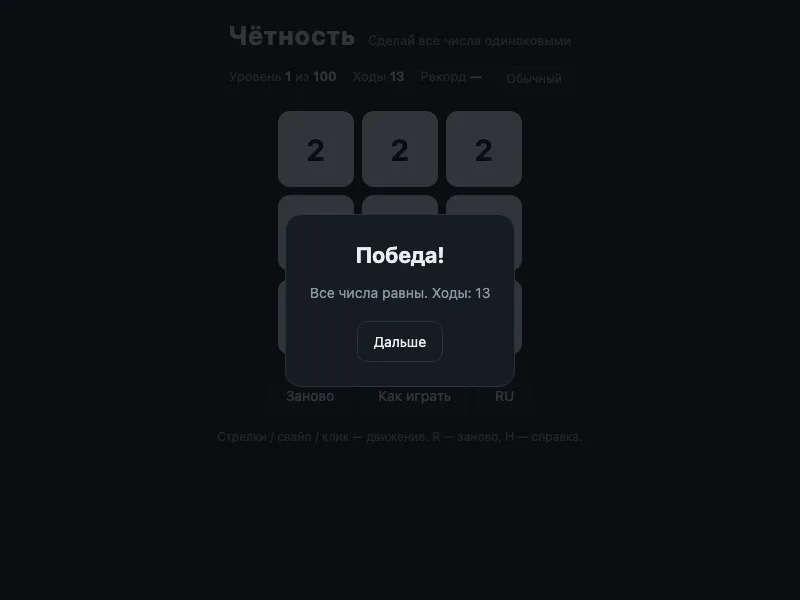
Level 1 takes 13 moves. It looks like the game is only teaching you the mechanic — yet by level ten you are no longer counting cells, you are counting their differences.
Black & white mode
From level 51 the rules break. Black & white mode kicks in: white cells still add 1, but black ones subtract 1. Same moves, opposite sign. The very solution that worked in the vanilla half now drags you away from the goal. The second half is a mechanic you have to relearn on a board you already know.
Under the hood
- 100 levels: 50 vanilla and 50 black & white, difficulty rising smoothly
- Progress and your best move count are saved in the game
- Controls: arrow keys, swipes on mobile, or click a neighbouring cell
- Russian and English interface with an in-game switch
- Zero external requests: the game is fully self-contained
Where it came from
This is an adaptation of Parity by Abe Fehr (MIT licence). The original shipped with jQuery, the Clay SDK, Facebook and ad blocks — all of that had to go. What is left is the pure mechanic on vanilla DOM: 100 levels, no dependencies and not a single network call.