Sorting Line: Fractions
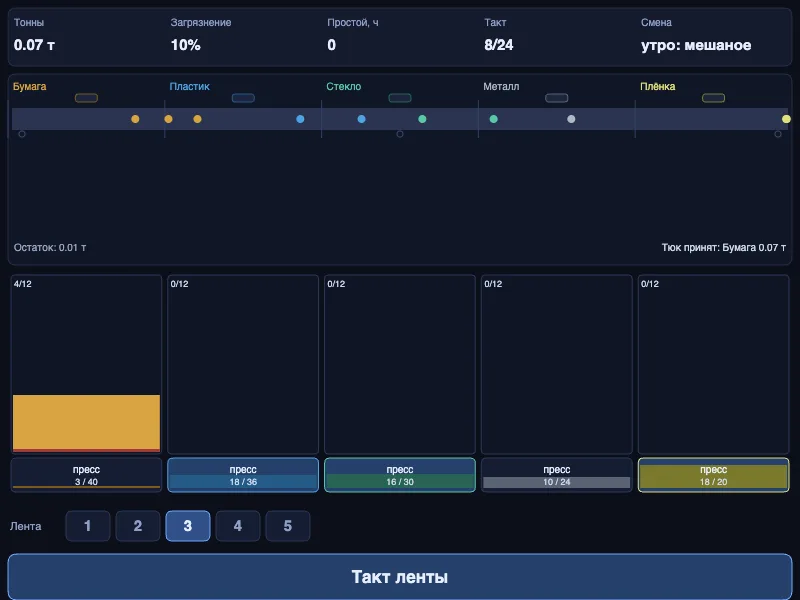
A recycling line is a speed problem that cannot be solved with speed alone.

The flow. At the start of the shift it is mixed household waste: a little of everything and all of it dirty. By lunch paper arrives — a heap, but waste paper fears water and film nearby. In the evening it is film: light, flying, jamming the rollers. The player does not steer the flow, only the belt.
Picking stations. Each zone has its limit: a person grabs so many items a minute. Speed the belt up and part of the flow slips past the hand into the general residue — that is a lost tonne. Slow it down and the hoppers under the stations overflow, and the whole line stops.
Contamination. The baler accepts a clean fraction. A bundle of paper mixed with film takes neither: the batch is turned back, and a turn-back is a second pass plus downtime. So 'fast' on its own costs more than 'clean'.
Containers. Bins run out at different moments: an overflowing bin is the same stopped line, just with a nice view of the chart.
The score. Tonnes per fraction, contamination percent, idle hours. The shift act per station: where they grabbed fast and dirty, where slow and clean — and which of the two cost more.