KenKen: sudoku that makes you do arithmetic
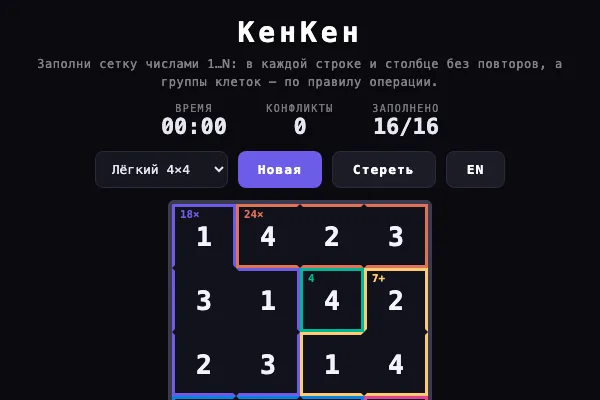
If sudoku has started to feel mechanical, this is the natural next step. The base rule is the same — no repeats in a row or column — but the hints are not given digits. They are arithmetic.
Two rules, two layers
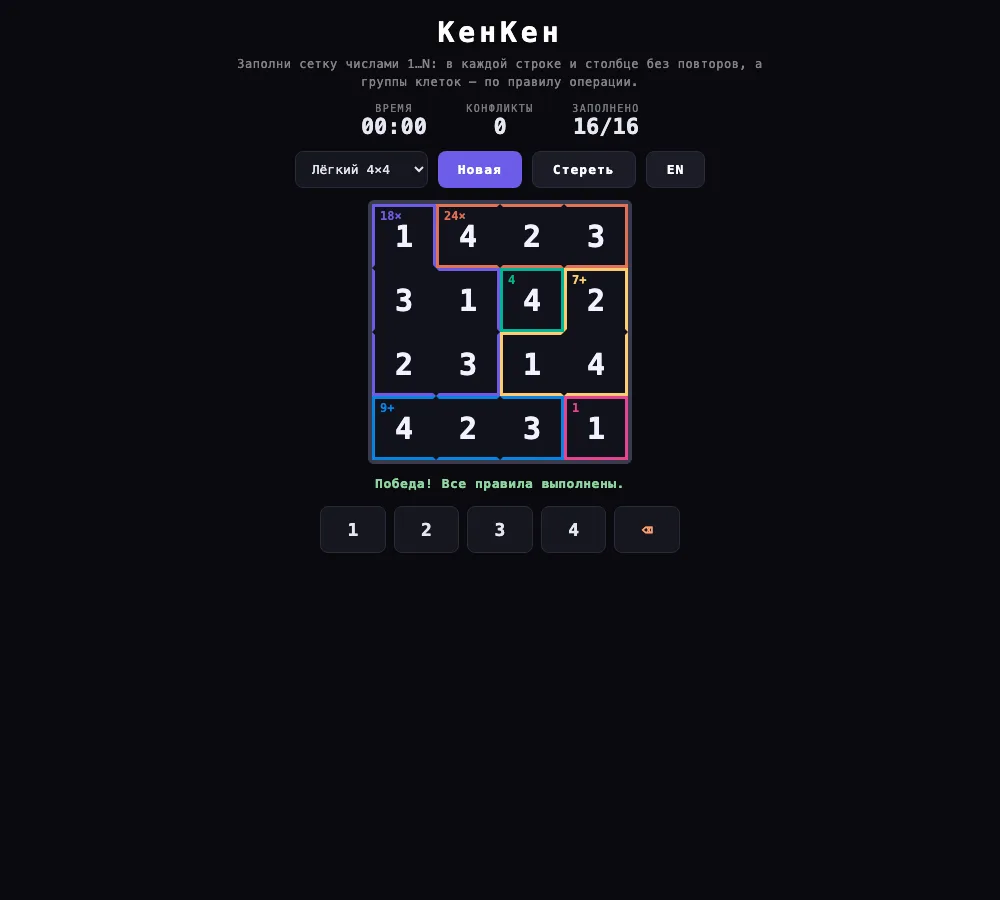
The first layer is the Latin square: fill the grid with 1 to N so that nothing repeats along any row or column. The second layer is the cages, the outlined groups of cells. Each cage carries a target and an operator, and the numbers inside must produce that target.
They pull in different directions, and that is the whole point. Uniqueness says "not this digit here". Arithmetic says "these two cells multiply to 6". Sometimes the cage settles the cell, sometimes the row does, and part of the skill is noticing which of the two is talking to you right now.
Where to start on a fresh grid
Look for cages with a single candidate set. A two-cell cage marked "× 6" on a 4×4 can only be 2 and 3 — nothing else multiplies to 6 inside the range. Same story with a two-cell "+ 3": that is 1 and 2. Those cages are free information, and they usually unlock a row.
Subtraction and division cages are the trap. "− 1" tells you the difference, not the values, so it gives you a family of pairs rather than an answer. Leave them and come back once the row has narrowed things down.
Practical advice
- Start at 4×4 even if sudoku is easy for you: the mental gear here is different, and small grids teach cage reasoning fast.
- Use the conflict counter as a compass rather than a verdict. It tells you a rule is broken somewhere, which means it is time to recheck the last cage you filled.
- On 6×6 grids write out the candidate sets for large cages before you place anything. Three cells adding to 12 have many splits, and holding them in your head is where errors come from.
Grids are 4×4, 5×5 and 6×6, so a quick puzzle before the kettle boils works as well as a long sit-down.