Kriegspiel: Blindfold Chess — a board where the enemy exists only in the log
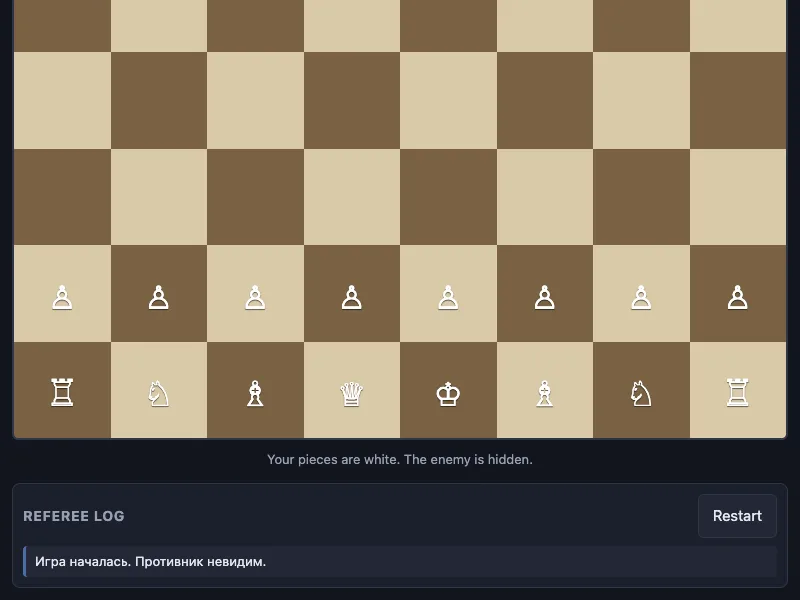
In ordinary chess you pick a move from the position. In Kriegspiel you build the position first — and only then pick the move. Your own pieces are on the board; the enemy's are not. The opposing side exists only in what the referee says about it.
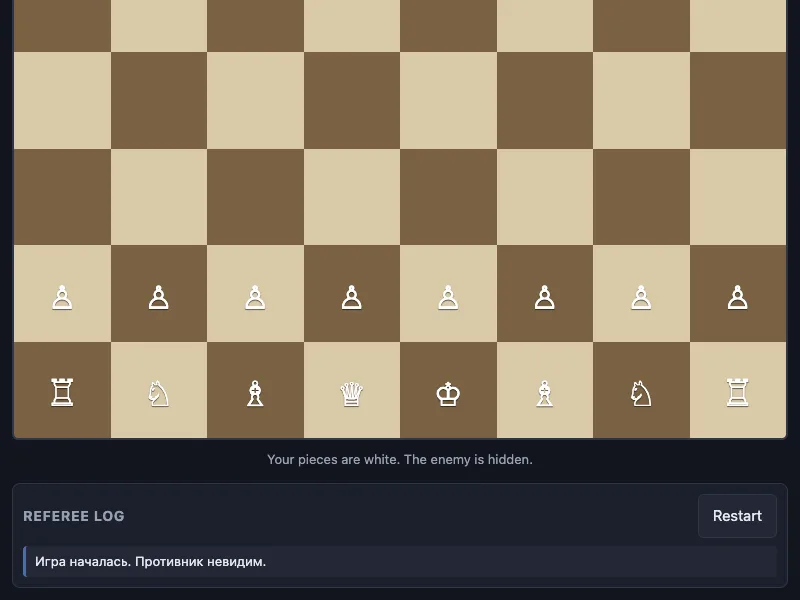
This is not "blindfold chess" where you simply do not look at the screen. It is a different task, and it is solved from different material.
What you see and what you do not
An 8×8 board, white is yours, all 16 pieces. There is not a single black piece: none at all. They appear only when they capture one of yours.
The opponent meanwhile plays by real rules on the same board. It does not cheat: it has a king, rooks, bishops, a knight, eight pawns, and it moves them honestly. You just never see them, and it sees everything.
This produces two mistakes that ordinary chess never gives you. The first: a move that looks safe walks into a piece standing where you never saw one. The second: a square that looks occupied is empty, and you do not go where you should.
Information channels and what they mean
The referee answers every attempted move, and each answer is data, not an error message.
"No" — the move is refused. This is not "you missed the board": this game has no missing the board. "No" means the move breaks the rules, loses your own king, or steps into an attack you cannot see. The refusals counter shows how many times the referee stopped you: forty refusals in a row and the game is a draw, because otherwise a game without progress would never end.
"Can't get there" — the most valuable answer. It does not say "good try": it says something specific. Your piece can move that way, so something stands between the squares. Your own pieces are already visible, so the blocker is an enemy piece. You have just located a piece on a line.
"Check!" — the only way to learn about an enemy piece without losing one of yours. Check always arrives along a rank or a diagonal from a rook, bishop, or queen, so together with the news you get the line that piece lies on.
"Rook on E4" — the opponent captured your piece. You lose material, but you learn where it stands: that square is now occupied, and you can assume moves from it.
Why it is not "another chess game"
The value of Kriegspiel is not in the rules — those are the same, with three differences: the referee will not carry out a self-capture or a move into check, a pawn on the last rank becomes a queen by itself, and there is a refusal limit. The value is that skill transfers badly: a game where you are strong in the classical version does not help here.
Start with pawns and the knight. A pawn reveals the square in front: if the move is refused, something is there. The knight checks a square by jumping, so it learns occupancy directly, bypassing the question of what stands on the path. Opening rooks, bishops and queens early is not worth it: you cannot see who is waiting to meet them.
Material is counted differently too. In ordinary chess the balance is read off the board; here it is read off your own losses. If you have lost exactly a rook, the opponent may never have had a queen at all. That sounds like a detail, and it decides whether risking the queen is sane.
After the checkmate
When the game ends in checkmate, stalemate, or a draw, the hidden side stays hidden — this version does not reveal the opponent's position. But the referee log remains: from it you can see what the picture was built from, and where it diverged from the truth.
The referee keeps a log, not a hint list. That is the game.