Factors: 256 levels of aiming for the number one
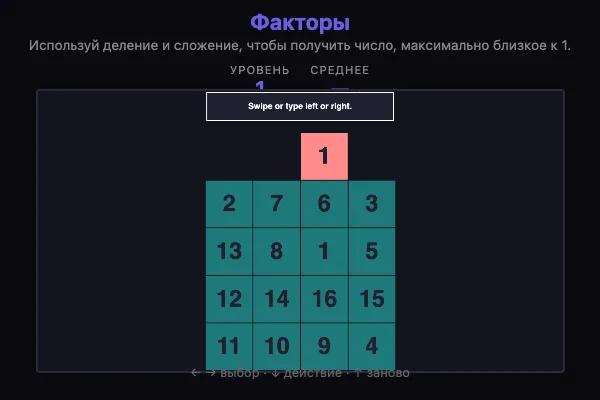
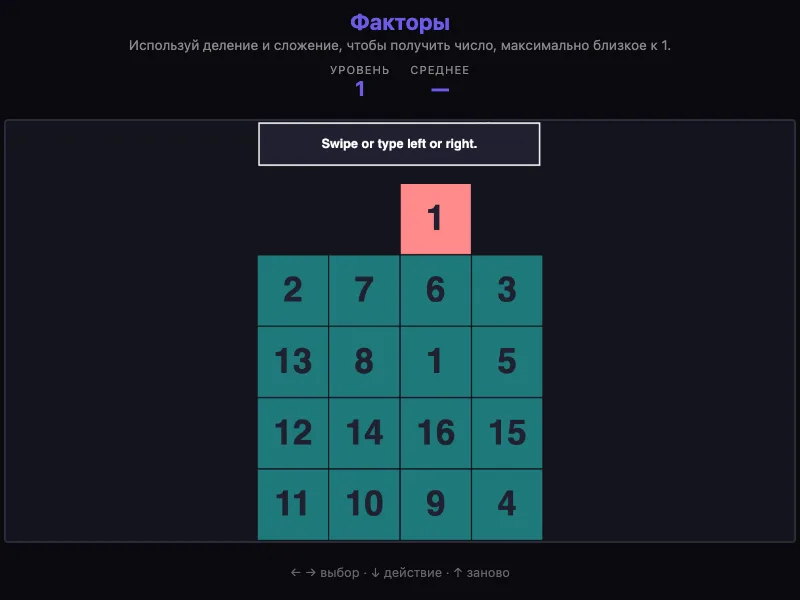
The rules take ten seconds to explain and the late levels take a scrap of paper. You get a number, two tools — divide by a prime factor, or add that factor back — and a goal that sounds odd at first: land as close to 1 as possible.
Why the target is 1
It inverts the arithmetic instinct we grew up with. We are trained to believe bigger is better; here the closer your result sits to one, the higher your level score. Division pulls the number down, addition pushes it up, and the entire level is about steering with those two levers toward a point rather than sailing past it.
You can miss in both directions, and that is the interesting part: overshooting with division drops you below one just as painfully as stopping short leaves you above it.
Where it gets hard
Early levels fall to greed: divide by whatever you can, add what is left. Then a number turns up whose useful divisor must be applied after an addition rather than before, or the factor is wasted. From that point on the game asks you to look two or three moves ahead, because the order of operations matters more than the set of them.
Practical habits
- Factor the number in your head before your first move — it shows you which levers exist at all.
- Do not grab the largest divisor first; usually you want it at the end, to close the gap.
- The restart key (↑) is cheaper than a bad average: with 256 levels you are scored on mean deviation.
Who it suits
People who enjoy arithmetic as a game rather than a duty, and anyone who wants something you can dip into for five minutes and leave with progress intact. Four arrow keys, one hand.