Echo Drift: the puzzle where the board vanishes behind you
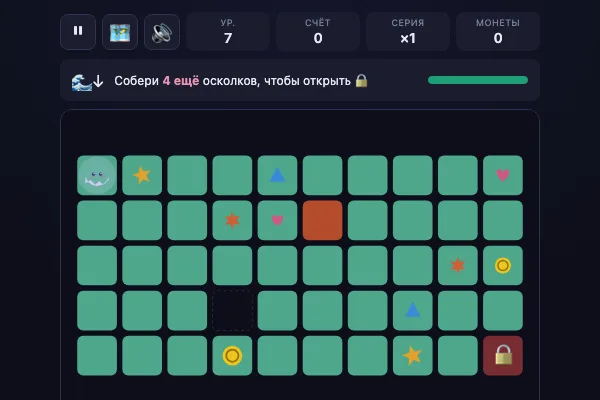
A normal grid puzzle is patient: the board sits still and waits while you work out a route. Echo Drift is built the other way round. You are a fading memory, and the flood of forgetting follows, erasing rows one after another. A tile you crossed a minute ago may no longer exist.

That produces the core difference: you are not solving how to reach the goal, you are solving in what order you can make it.
The rules in a minute
The board is scattered with shards of four emotions: ★ Joy, ▲ Fear, ♥ Love, ✸ Anger. Collect as many as the level demands and the memory core unlocks. Reach the core and the level is done.
The flood arrives from one side — two on later levels — and the side changes every time: checking the 🌊 arrow in the header is the first thing to do on a new level. A flooded tile is gone. If you were standing on it, so are you.
The core is flood-proof and sits on the safe side — which is to say, as far from you as possible.
Collection order beats route planning
The classic beginner mistake is heading for the nearest shard. The opposite is correct: take what is closest to the flood side first. The far shards are not going anywhere; the ones at the waterline will be gone in seconds.
The second habit is not backtracking. Every step back costs two: while you walk back, the water eats another row. A good route looks like a single arc from the start through every required shard to the core, not a star centred on your spawn tile.
Four powers that cost no turn
Every four shards of one emotion charge an ability:
- Joy — a dash: for a couple of seconds you step two tiles at a time. It saves you when a void sits between you and the core.
- Fear — a freeze: the flood stops for four seconds. The best use is not "when scared" but when the last shard is exactly four seconds away.
- Love — a rebuild: restores erased tiles around you. It can undo a mistake — a severed path to the core, for instance.
- Anger — a blast: pushes the water three rows back. The strongest effect of the four, and the only one that literally buys time.
Note: powers do not cost a turn. Saving them "for later" is pointless — later may not happen.
Five chapters, five new ways to complicate your life
Each chapter stacks a mechanic on the previous ones, and by the finale they all run at once:
| Chapter | What is added |
|---|---|
| Childhood | the flood, shards, thorns, voids |
| Growing Up | fragile tiles — they collapse the moment you step off |
| First Love | portals warp in pairs, ice sends you sliding |
| Ambition | shadows of doubt hunt you, locked gates open with a key |
| Twilight | a current drifts you a tile, the water closes from two sides |
The nastiest mechanic is neither the shadows nor the gates — it is ice. Step onto it and you slide until something stops you, so "one step" becomes four tiles in the wrong direction. Ice must be aimed at, not walked onto.
Coins and the shop
Levels drop coins. The shop sells five spirit skins (cosmetic) and three upgrades that genuinely change the game: less stability damage, a later first flood, and coins that drift to you from an adjacent tile. Upgrades are bought once and always active.
The levels are deterministic — and that matters
Boards are generated from the level number, not at random: identical on every run. A failed level can be picked apart step by step and then cleared cleanly for three stars. All 50 levels are automatically verified as solvable, so there is no such thing as an impossible one here — only a misread one.
Level picker for registered players
Clearing fifteen easy levels to reach the portals is boring. So registered players get a picker above the game: type a number from 1 to 50 and start there. Guests see an invitation to register instead — registration is free and exists for exactly this.
Is it worth playing
If you like puzzles that ask you to think fast rather than long — yes. Chapter one teaches honestly, chapter two already demands planning three moves ahead, and by chapter five you will be counting seconds to the flood the way a chess player counts tempo. A couple of levels take five minutes; all fifty take a few evenings.
The interface is available in Russian and English; switch with the button on the game page.
🎮 Play: Echo Drift