Foundry: Pour and Cool
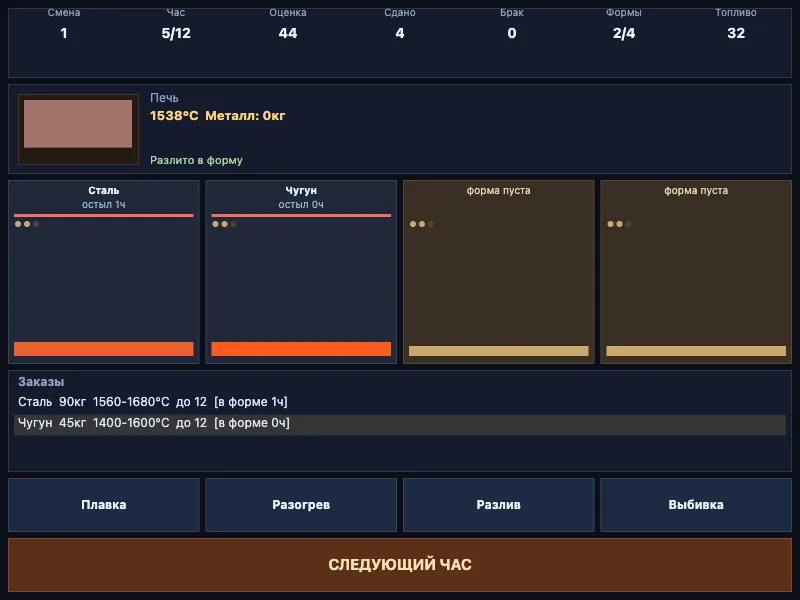
The first casting fails quietly: metal poured, mould intact, and the shakeout reveals a crack along the edge. Cooling, it turns out, is also a decision and not a pause.

Three resources argue inside Foundry. The furnace holds a finite amount of metal: pour too much and the leftovers go back for remelting at the price of fuel. Temperature is chosen before the pour: overheat burns off the alloying elements and the piece looks fine while failing strength; underheat never fills the thin sections and gives a cold shut. Cooling rate is the third lever and it lives in time, not in buttons — an early shakeout cracks the piece, a late one leaves a coarse grain and a missed deadline.
Sand moulds are repaired after every shakeout, never completely. By mid-shift there are fewer moulds than orders, so the player starts choosing which order to break: the one that pays more, or the one that is closer to its date. There is no correct button here, only a price, and the debrief shows it.
The debrief is honest: each casting is annotated with what actually killed it — temperature, a hurried mould, or missing metal. Which is why the second shift plays differently from the first, and it is the only teaching this simulator needs.