Neuroevolution: fighting neural nets that learn from your mistakes
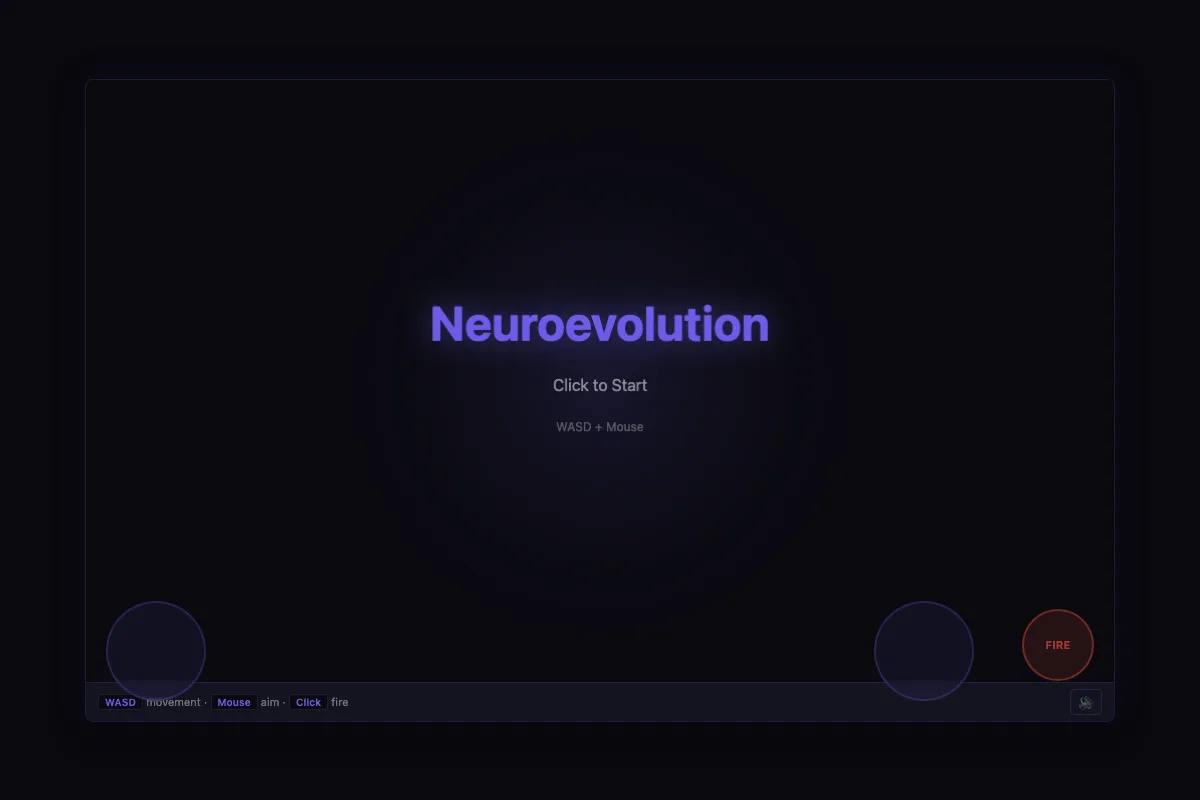
Most arena shooters ship with enemies whose behaviour was frozen by a programmer months before you pressed Start. This one does not. Everyone on the arena except you is a neural network, and between rounds the survivors breed. Play badly and you will not notice. Play well, and by generation ten the arena starts hunting you back.
The trick under the hood
Each opponent is a small network that reads the arena and outputs movement and firing. Nobody scripted "circle the player" or "retreat at low health" — the behaviour is scored instead. Fitness comes from hits landed, time survived and aggression, and it is docked for friendly fire and for blowing yourself up. When the round ends, the top scorers are crossed over and mutated into the next generation.
That single detail changes the feel of the game. The first generations flail: they spray at walls, shoot each other, wander into their own explosions. Then a generation appears that has learned to keep its distance. Then one that leads its shots.
Why it is worth a session
- You are not memorising an attack pattern, because there is no fixed pattern to memorise.
- Your own habits become the training data. If you always strafe right, that gets exploited.
- The generation counter is a scoreboard for both sides at once — it tells you how long you have lasted and how far the nets have come.
Reading the arena
Watch the hit counter rather than the health bar. Health regenerates slowly, so a slow leak is survivable; a rising hit rate means this generation has genuinely learned to aim, and the fight is about to change character. When that happens, stop trading shots in the open and make the nets come to you.
Friendly fire is a real weakness in early generations — stand so that two opponents line up and let them do the work. Later generations mostly grow out of it, which is exactly the point.